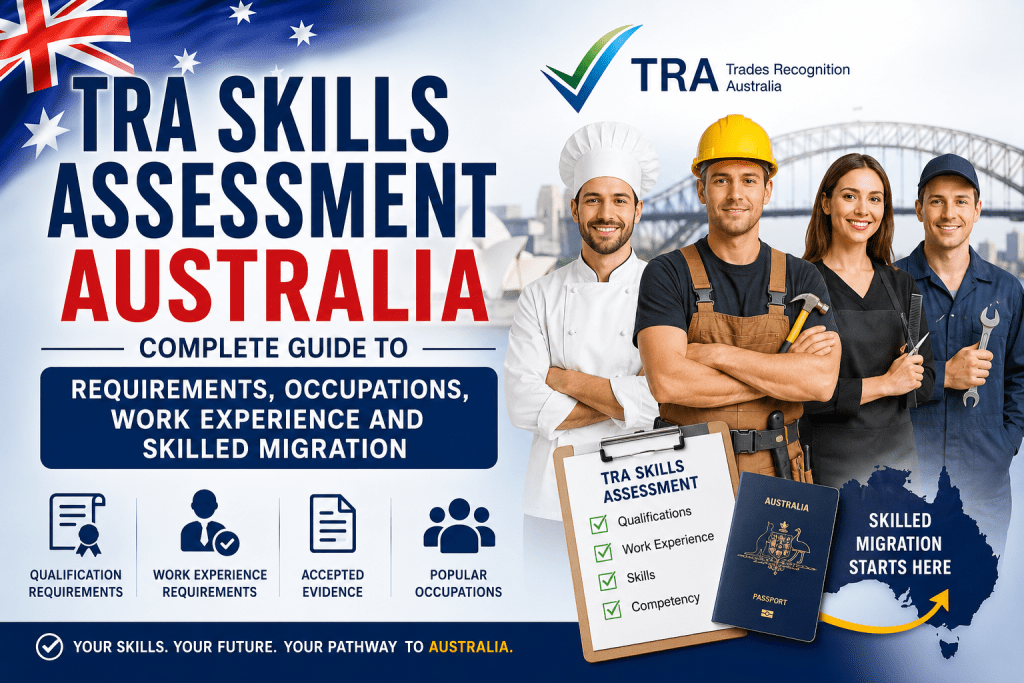
If you are planning to migrate to Australia as a qualified tradesperson, obtaining a positive TRA Skills Assessment may be one of the most important steps in your migration journey.
Every year, skilled workers apply for Australian migration pathways under occupations such as Chef, Cook, Baker, Carpenter, Welder, Motor Mechanic, Diesel Motor Mechanic, Hairdresser, Air Conditioning and Refrigeration Mechanic, Cabinetmaker, Fitter and Turner, Panelbeater and many other trade occupations.
For many skilled migration and employer-sponsored visa pathways, applicants may need to demonstrate that their qualifications, training and work experience meet Australian industry standards. This is where Trades Recognition Australia (TRA) plays an important role.
In this complete guide, we explain:
- What a TRA Skills Assessment is
• Who may require a Skills Assessment
• TRA assessment pathways
• Qualification requirements
• Work experience requirements
• Common supporting evidence
• Common reasons for unsuccessful outcomes
• Occupations assessed by TRA
• Frequently asked questions
Whether you are applying from Australia or overseas, this guide will help you better understand the TRA assessment process and prepare a stronger application.
WHAT IS TRADES RECOGNITION AUSTRALIA (TRA)?
Trades Recognition Australia (TRA) is an Australian Government-approved skills assessing authority responsible for assessing many trade and technical occupations for migration purposes.
TRA evaluates whether an applicant’s qualifications, skills and employment experience are comparable to the requirements of their nominated occupation.
A positive assessment indicates that the applicant’s qualifications and employment experience have been assessed as meeting the relevant assessment criteria for the nominated occupation.
Many skilled migration and employer-sponsored visa pathways may require a positive Skills Assessment as part of the visa application process.
WHY IS A SKILLS ASSESSMENT REQUIRED?
Skills Assessments are used to evaluate whether an applicant’s qualifications, skills and employment experience are comparable to the requirements of their nominated occupation for migration purposes.
A Skills Assessment may help verify:
- Occupational competency
• Qualification relevance
• Employment history
• Industry experience
• Technical knowledge
• Practical workplace skills
The assessment process supports industry standards and helps maintain the integrity of Australia’s skilled migration system.
POPULAR OCCUPATIONS ASSESSED BY TRA
TRA assesses a wide range of trade and technical occupations across various industries.
Popular occupations include:
- Chef
• Cook
• Baker
• Pastrycook
• Carpenter
• Welder
• Motor Mechanic
• Diesel Motor Mechanic
• Hairdresser
• Cabinetmaker
• Air Conditioning and Refrigeration Mechanic
• Fitter and Turner
• Panelbeater
Which Australian Visas May Require a TRA Skills Assessment?
A TRA Skills Assessment may be required for:
Skilled Independent Visa (Subclass 189)
A points-tested permanent residency visa that does not require sponsorship.
Skilled Nominated Visa (Subclass 190)
A permanent residency pathway sponsored by an Australian State or Territory.
Skilled Work Regional Visa (Subclass 491)
A regional migration pathway.
Employer Nomination Scheme (Subclass 186)
A permanent employer-sponsored visa.
Skills in Demand Visa (Subclass 482)
An employer-sponsored temporary work visa.
Skilled Employer Sponsored Regional Visa (Subclass 494)
A regional employer-sponsored pathway.
Temporary Graduate Visa (Subclass 485)
For eligible international graduates.
TRA Assessment Pathways
Migration Skills Assessment (MSA)
The Migration Skills Assessment is one of the most common pathways for applicants seeking permanent migration.
This pathway is generally available to applicants whose occupation falls under TRA’s assessment responsibilities and who meet qualification and employment requirements.
Offshore Skills Assessment Program (OSAP)
The Offshore Skills Assessment Program is commonly used by offshore applicants applying under nominated occupations.
Many popular occupations assessed through OSAP include:
- Chef
- Cook
- Baker
- Pastrycook
- Carpenter
- Welder
- Diesel Motor Mechanic
- Motor Mechanic
- Cabinetmaker
Skills in Demand Visa Assessment
Applicants applying for employer-sponsored migration may require a TRA assessment depending on their occupation and nationality.
Provisional Skills Assessment (PSA)
Suitable for eligible international graduates who completed their studies in Australia.
Job Ready Program (JRP)
Designed to help Australian trade graduates demonstrate workplace competency before migration.
What Does TRA Assess?
A TRA Skills Assessment generally focuses on three key areas:
- Identity
Applicants must establish their identity using official government-issued documents.
- Qualifications
TRA assesses:
- Qualification level
- Qualification relevance
- Training provider legitimacy
- Course content
- Learning outcomes
- Employment Experience
TRA reviews whether employment demonstrates practical application of occupational skills.
TRA Qualification Requirements
One of the most common reasons for an unsuccessful Skills Assessment is a qualification that does not sufficiently relate to the nominated occupation.
TRA generally expects qualifications to be comparable to Australian trade standards.
Acceptable qualifications may include:
- Certificate III
- Certificate IV
- Diploma
- Advanced Diploma
- Associate Degree
The qualification must be directly relevant to the occupation being nominated.
Can Overseas Qualifications Be Accepted?
Yes.
Many successful applicants hold qualifications obtained outside Australia.
TRA may consider:
Qualification Quality
Whether the institution is recognised and accredited.
Qualification Level
Whether the qualification is comparable to Australian standards.
Qualification Relevance
Whether the training content relates directly to the nominated occupation.
Can RPL Qualifications Be Used?
Recognition of Prior Learning (RPL) qualifications may be accepted in some TRA assessment pathways where they meet the relevant requirements.
Applicants should understand that a qualification alone is generally not sufficient. Employment evidence and practical industry experience remain important parts of the assessment process.
TRA Work Experience Requirements
Work experience is one of the most important parts of a Skills Assessment.
Generally, employment should be:
- Genuine
- Paid
- Relevant
- Verifiable
- Supported by documentary evidence
The duties performed should closely match the nominated occupation.
What Documents Does TRA Usually Accept?
Common documents include:
Identity Documents
- Passport
- Government-issued identification
Qualification Documents
- Certificates
- Diplomas
- Academic transcripts
- Statements of attainment
Employment Documents
- Reference letters
- Payslips
- Tax records
- Bank statements
- Employment contracts
- Invoices
- Business registration documents
Popular Occupations Assessed by TRA
Chef Skills Assessment Australia
Chef is one of the most popular occupations assessed by TRA. Applicants generally need relevant qualifications and employment demonstrating menu planning, food preparation, kitchen supervision and commercial cooking experience.
Cook Skills Assessment Australia
Cook applicants must demonstrate practical cooking experience and relevant training.
Baker Skills Assessment Australia
Baker applicants need evidence of baking production, recipe preparation and commercial baking operations.
Carpenter Skills Assessment Australia
Carpenters must demonstrate construction and installation experience across a variety of carpentry tasks.
Welder Skills Assessment Australia
Welders are assessed on fabrication, welding processes and practical trade experience.
Motor Mechanic Skills Assessment Australia
Applicants must demonstrate fault diagnosis, repairs and vehicle maintenance skills.
Diesel Motor Mechanic Skills Assessment Australia
Diesel mechanics need experience working with heavy vehicles, machinery or diesel engines.
Hairdresser Skills Assessment Australia
Hairdressers are assessed on cutting, colouring, styling and client service skills.
Common Reasons for Unsuccessful Skills Assessments
Many negative outcomes occur because of:
- Qualification mismatch
- Insufficient employment
- Weak reference letters
- Missing evidence
- Inconsistent employment history
- Unverifiable documents
- Poor document quality
- Duties not matching occupation requirements
HOW TO PREPARE A STRONGER APPLICATION
✔ Select the most appropriate occupation
✔ Review qualification suitability before applying
✔ Prepare strong employment evidence
✔ Ensure duties align with the nominated occupation
✔ Keep employers and referees available for verification
✔ Submit complete and accurate documentation
✔ Seek professional guidance where appropriate
Why Choose Number One Service?
Number One Service assists clients across Australia and overseas with Skills Assessment applications.
Our team provides support with:
- Occupation assessment
- Qualification review
- Employment evidence preparation
- Skills Assessment applications
- Interview preparation
- Additional information requests
- Ongoing case management
We work closely with clients to ensure applications are prepared accurately and professionally.
50 Frequently Asked Questions (FAQs) About TRA Skills Assessments
- What is a TRA Skills Assessment?
A TRA Skills Assessment is an evaluation of your qualifications, skills, and work experience to determine whether they meet Australian industry standards for your nominated occupation.
- Who conducts TRA Skills Assessments?
Depending on the occupation and visa pathway, a positive Skills Assessment may be required for skilled migration or employer-sponsored visa applications.
- Why do I need a TRA Skills Assessment?
A positive Skills Assessment is often required for skilled migration and employer-sponsored visa applications.
- Which visas may require a TRA Skills Assessment?
Common visas include Subclass 189, 190, 491, 482, 186, 494, and 485 (where applicable).
- Can I apply for a Skills Assessment while overseas?
Yes. Many applicants complete their Skills Assessment from outside Australia.
- Can I apply for a Skills Assessment while in Australia?
Yes. Both onshore and offshore applicants can apply, depending on eligibility.
- What occupations does TRA assess?
TRA assesses over 130 trade and technical occupations, including Chef, Cook, Baker, Carpenter, Welder, Motor Mechanic, Hairdresser, and many others.
- How do I know if TRA is the correct assessing authority for my occupation?
You should check the occupation requirements or seek professional advice before applying.
- What is a positive Skills Assessment?
A positive outcome means your qualifications and work experience meet the required Australian standard for your nominated occupation.
- Does a positive Skills Assessment guarantee visa approval?
No. A Skills Assessment is only one requirement of the visa process.
- What qualifications are accepted by TRA?
TRA generally accepts qualifications that are relevant to the nominated occupation and comparable to Australian standards.
- Can overseas qualifications be accepted?
Yes, provided they are recognised, relevant, and comparable to Australian qualifications.
- Can I use a qualification obtained through RPL?
In many TRA pathways, qualifications obtained through Recognition of Prior Learning (RPL) may be accepted.
- Does my qualification need to exactly match my occupation?
Not always, but it should be closely related and relevant.
- What if my qualification is in a different field?
TRA may consider the qualification, but relevance to the nominated occupation is extremely important.
- Do I need to submit academic transcripts?
In most cases, yes.
- Are trade certificates accepted?
Yes, provided they meet the requirements of the assessment pathway.
- Can I use multiple qualifications?
Yes, if they support your nominated occupation and application.
- What if my qualification was completed many years ago?
Older qualifications can still be accepted if supported by relevant work experience.
- Do I need English translations for non-English documents?
Yes. Documents not in English should be translated by an authorised translator.
- How much work experience is required?
Requirements vary depending on the occupation and assessment pathway.
- Does casual work count?
It may be accepted if properly documented.
- Does part-time work count?
Yes, although TRA may calculate the equivalent full-time experience.
- Can self-employment be accepted?
Yes, if supported by strong evidence.
- Can subcontract work be accepted?
Yes, many subcontractors successfully complete Skills Assessments.
- What evidence is required for self-employment?
Evidence may include invoices, tax records, bank statements, contracts, and business registration documents.
- Can unpaid work experience be used?
Generally, paid employment is preferred.
- Does volunteer work count?
Usually not for trade Skills Assessments.
- What if I have employment gaps?
Employment gaps do not automatically cause a negative outcome, but they may need explanation.
- Does overseas work experience count?
Yes, if it is relevant and supported by evidence.
- What documents should I submit with my application?
Common documents include passports, qualifications, transcripts, employment references, payslips, and tax records.
- Are payslips mandatory?
Requirements vary, but strong payment evidence is usually recommended.
- Can bank statements be used as evidence?
Yes, in many cases.
- Can tax records be used as evidence?
Yes, tax documents are often useful supporting evidence.
- Does TRA verify documents?
Yes. TRA may conduct verification checks.
- Can TRA contact my employer?
Yes.
- Can TRA contact my referee?
Yes.
- What happens if my employer cannot be contacted?
TRA may request additional evidence.
- What if the company has closed down?
Alternative evidence may still be accepted.
- Can I submit additional documents after lodgement?
Sometimes additional documents may be requested during assessment.
- How long does a Skills Assessment take?
Processing times vary depending on the pathway and application complexity.
- What happens if my application is unsuccessful?
Depending on the program, review or reassessment options may be available.
- Can I apply again after a negative outcome?
Yes, provided you address the issues identified in the previous assessment.
- Can I change my nominated occupation after applying?
Generally, a new application may be required.
- How long is a Skills Assessment valid?
Validity periods vary depending on the program and visa requirements.
- Can I use the same Skills Assessment for multiple visa applications?
Often yes, provided the assessment remains valid.
- What is the biggest mistake applicants make?
Submitting weak or inconsistent employment evidence.
- Should I prepare all documents before applying?
Yes. A well-prepared application can help avoid delays.
- Do I need professional assistance for a Skills Assessment?
Professional assistance is not mandatory. However, some applicants choose to seek guidance to better understand assessment requirements and prepare supporting documentation. Assessment outcomes are determined solely by the relevant assessing authority.
50. How can Number One Service help with my TRA Skills Assessment?
Number One Service provides assistance with occupation reviews, qualification assessments, employment evidence preparation, Skills Assessment application support, interview preparation and general guidance throughout the Skills Assessment process. Assessment outcomes are determined by the relevant assessing authority.
Contact Number One Service
Phone: 0421 300 976
Email: [email protected]
Website: www.numberoneservice.com.au
Need assistance with your Skills Assessment? Contact our team today.
Disclaimer
This article provides general information only and does not constitute migration, legal, financial or professional advice. Skills Assessment requirements, occupation eligibility, fees, processing times and assessment criteria may change without notice. Applicants should refer to the relevant assessing authority and official Australian Government sources for the most up-to-date information. Individual circumstances vary and outcomes cannot be guaranteed.